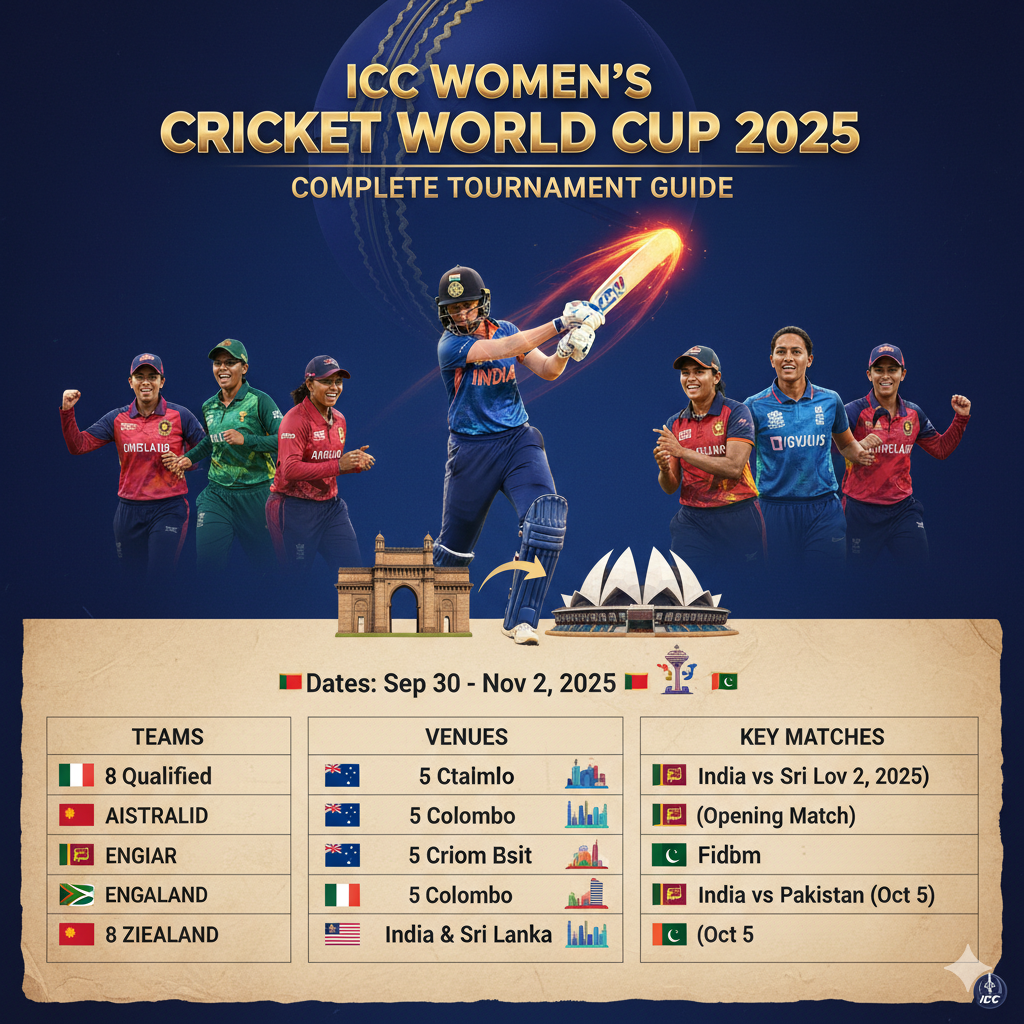
The wait is almost over. In just a few days, the cricketing world will witness history unfold as the ICC Women’s Cricket World Cup 2025 kicks off across India and Sri Lanka. With the first ball set to be bowled on September 30, eight of the world’s best women’s cricket teams are ready to battle for the sport’s most coveted prize.
This isn’t just another tournament – it’s the 13th edition of women’s cricket’s premier competition, and it promises to be the biggest and most competitive yet. From record-breaking prize money to a format that guarantees edge-of-your-seat cricket, here’s everything you need to know about this month-long festival of cricket.
The Contenders: A Mix of Champions and Dream Chasers
When it comes to pedigree, Australia sits at the top of the mountain. The defending champions have claimed the Women’s World Cup trophy an incredible seven times, making them the tournament’s most successful nation. They’ll arrive as favorites, but they know the target on their back has never been bigger.
England, cricket’s birthplace, aren’t far behind with four World Cup victories under their belt. The 2022 runners-up will be desperate to go one step further this time, especially with the tournament being held in familiar subcontinental conditions.
New Zealand remains the only other nation to taste World Cup glory, their lone triumph coming back in 2000. But here’s where it gets interesting – five teams have never lifted this trophy. Bangladesh, India, Pakistan, South Africa, and hosts Sri Lanka are all hunting for that maiden title, and there’s nothing more dangerous than a team with nothing to lose and everything to prove.
A Format Built for Drama
Forget complicated group stages and mathematical equations. The ICC has kept it simple for 2025 – all eight teams play each other once in a round-robin format. That’s seven matches per team, 28 games of pure competition where every single match matters.
The beauty of this format? No dead rubbers, no easy rides. Every team faces every other team, making it a true test of consistency and skill. After 28 matches, the top four teams advance to the knockout semi-finals, where it’s do-or-die cricket at its finest.
The semi-final matchups follow a classic format: first plays fourth, second plays third. The first semi-final is scheduled for October 29 in either Guwahati or Colombo, with the second semi-final set for October 30 in Navi Mumbai. Then comes the ultimate showdown – the final on November 2.
Where the Magic Happens: Venues Across Two Nations
Cricket fans are in for a treat with five spectacular venues hosting this tournament. In India, four cities will welcome the world’s best: Guwahati’s ACA Stadium, Indore’s Holkar Stadium, Visakhapatnam’s ACA-VDCA Stadium, and Navi Mumbai’s DY Patil Stadium.
Sri Lanka gets its moment in the spotlight too, with Colombo’s iconic Premadasa Stadium serving as the tournament’s lone Sri Lankan venue. The final could be held at either DY Patil Stadium or Premadasa Stadium, with both venues in contention to host cricket’s biggest prize.
Most matches will start at the cricket-friendly time of 3 PM local time, though there’s one exception – the England vs New Zealand clash on October 26 gets an earlier 11 AM start.
The Squads: Experience Meets Youth
The team announcements have been fascinating to watch unfold. India became the first team to announce their squad for the marquee event as they chase their maiden title. Each nation has been allowed to name 15-player squads, and the mix of experience and youth across all teams is remarkable.
Australia’s squad reads like a who’s who of women’s cricket, with captain Alyssa Healy leading a group that includes superstars like Ellyse Perry and Beth Mooney. England have handed the captaincy to Nat Sciver-Brunt for this tournament, a decision that speaks volumes about their evolution since their Ashes disappointment.
India, playing at home, will be led by the experienced Harmanpreet Kaur with Smriti Mandhana as vice-captain. The pressure of playing on home soil could either inspire them to greatness or weigh them down – that’s the beauty and burden of being hosts.
Getting Ready: The Warm-Up Phase
Before the main event kicks off, teams are fine-tuning their preparations through warm-up matches. Most teams get two practice games, though defending champions Australia will play just once – a sign of their confidence or perhaps their belief that less can be more.
The warm-up phase has already begun, with day one providing some early excitement and injury scares. These matches might not count in the official standings, but they’re crucial for teams to get their combinations right and adapt to local conditions.
Record-Breaking Investment in Women’s Cricket
Here’s a number that’ll make you sit up and take notice: $13.88 million. That’s the total prize pool for this World Cup, representing a staggering 297% increase from the 2022 edition. To put that in perspective, it even surpasses the $10 million prize pool from the men’s World Cup in India in 2023.
This isn’t just about money – it’s about recognition, respect, and the ICC’s commitment to growing women’s cricket. When players see this kind of investment, it validates their sacrifices and inspires the next generation.
Your Front Row Seat to History
The great news for cricket fans? This tournament will be more accessible than ever. With official broadcasters in every participating nation and ICC.tv streaming matches across various countries, you won’t miss a moment of the action.
Tickets are available at what the ICC calls “the most affordable pricing for any ICC global event in history.” Whether you’re planning to witness history in person or tune in from home, the infrastructure is in place for maximum enjoyment.
Why This Tournament Matters More Than Ever
This World Cup arrives at a pivotal moment for women’s cricket. The sport has never been more popular, more competitive, or more professionally structured. With the growth of domestic leagues worldwide and increasing investment in women’s cricket, the standard on display will be higher than ever before.
For hosts India and Sri Lanka, it’s a chance to showcase their cricket infrastructure and passion for the game. For the players, it’s about cementing legacies and creating new ones. And for fans worldwide, it’s about witnessing a month of cricket that could reshape the landscape of women’s sport.
As September 30 approaches, one thing is certain – the 2025 ICC Women’s Cricket World Cup is shaping up to be a tournament that no cricket fan can afford to miss. The stage is set, the players are ready, and history awaits.